Electrical Maintenance & Asset Management Programs
Reduce Failures. Improve Reliability. Protect Your Investment.
Electrical systems rarely fail without warning. Loose connections, aging equipment, deferred maintenance, and undocumented modifications often create conditions that lead to costly outages, equipment damage, and safety incidents.
Our Electrical Maintenance & Asset Management Programs help facilities identify risks early, document critical equipment, and establish a practical maintenance plan based on NFPA 70B maintenance best practices.
What Is Predictive Maintenance?
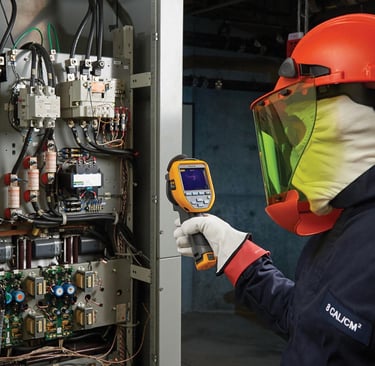
Predictive maintenance is the practice of monitoring equipment condition and identifying developing problems before failure occurs.
Instead of waiting for equipment to fail, predictive maintenance uses inspections, testing, infrared thermography, maintenance records, and condition assessments to identify risks while corrective action is still relatively inexpensive and easy to perform.
The goal is simple:
Find problems before they become failures.
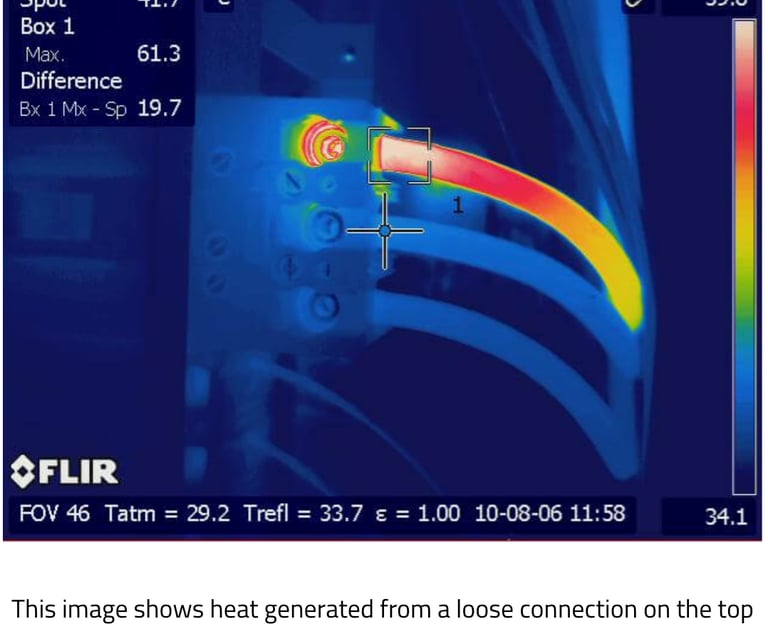
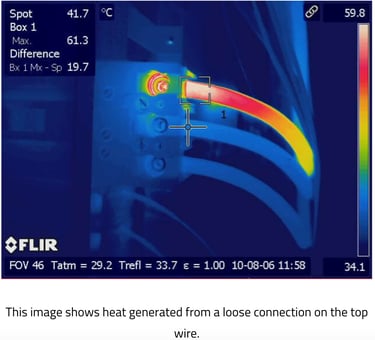
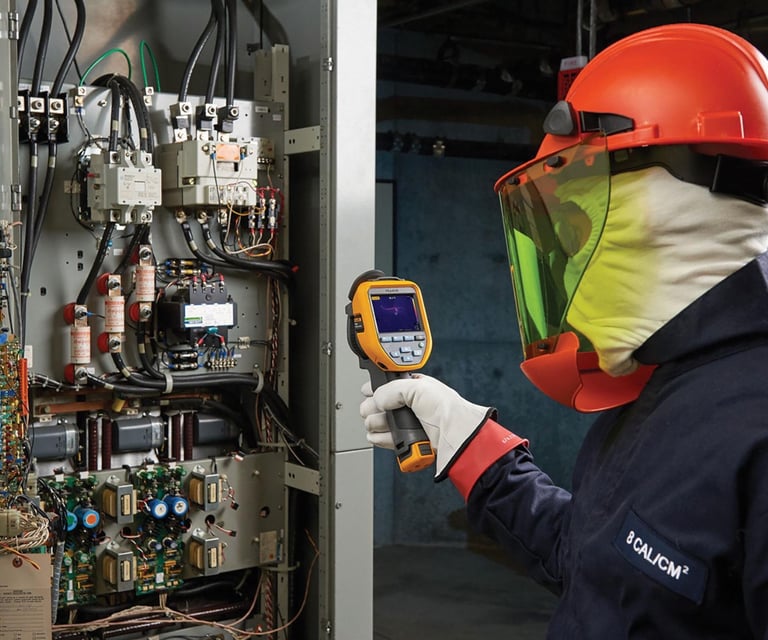
Finding this loose connection with an IR scan could mean a fix as simple as tightening with a torque wrench. Left untreated, it could permanently damage the panel and result in thousands of dollars in repair costs and forced downtime of your business's equipment.
The Business Case for Electrical Maintenance
Business consultants and industry authorities agree - Facilities with predictive maintenance programs commonly experience:
75% Reduction in Unexpected Equipment Failures ⚙️
Identifying developing problems before failure significantly reduces unplanned outages and emergency repairs.
35-45% Reduction in Downtime ⏱️
Maintenance programs help keep critical equipment available and operating when needed.
25-30% Reduction in Maintenance Costs 🔧💲
Planned maintenance is generally less expensive than emergency repairs and equipment replacement.
Up To 10x Return On Investment 📈
Many maintenance activities identify issues that can be corrected for hundreds of dollars rather than thousands.
Sources:
One Prevented Failure Can Pay For The Entire Program
A single overheated connection, failing breaker, or deteriorated component can result in equipment damage, downtime, and costly repairs.
Finding those problems early often pays for years of maintenance activities, as shown here and here.
Compliance, Documentation & Due Diligence
A reliable electrical system is not only good for operations—it is also an important component of workplace safety and risk management.
Industry standards such as NFPA 70E and NFPA 70B establish recognized practices for electrical safety and equipment maintenance. These standards are widely used throughout industry and are often referenced during safety evaluations, incident investigations, and insurance reviews.
A documented maintenance program helps demonstrate that equipment has been inspected, maintained, and evaluated using recognized industry practices.
Understanding the Standards
OSHA:
General Duty Clause: “shall furnish to each of his employees employment and a place of employment which are free from recognized hazards that are causing or are likely to cause death or serious physical harm to his employees.”
OSHA 1910.303(b)(1): Examination. Electric equipment shall be free from recognized hazards that are likely to cause death or serious physical harm to employees.
OSHA 1910.303(b)(5): Circuit impedance and other characteristics. The overcurrent protective devices, the total impedance, the component short-circuit current ratings, and other characteristics of the circuit to be protected shall be selected and coordinated to permit the circuit protective devices used to clear a fault to do so without the occurrence of extensive damage to the electrical components of the circuit. This fault shall be assumed to be either between two or more of the circuit conductors, or between any circuit conductor and the grounding conductor or enclosing metal raceway.
NFPA 70E – Electrical Safety in the Workplace
NFPA 70E is a national consensus standard developed by National Fire Protection Association at OSHA’s request to determine specifics of electrical work place safety as outlined here and here.The standard requires employers to assess electrical hazards and establish procedures that allow employees and contractors to work safely around energized electrical equipment. It also recognizes that the safety of electrical equipment depends on proper maintenance. It also recognizes that the safety of electrical equipment depends on proper maintenance.
NFPA 70E requires that electrical equipment shall be maintained to in accordance with manufacturer's instructions or industry consensus standards to reduce the risk associated with failure. (Section 205.4).
NFPA 70E 205.5 - Overcurrent Protective Devices: Overcurrent protective devices shall be maintained in accordance with the manufacturers’ instructions or industry consensus standards. Maintenance, tests, and inspections shall be documented.
NFPA 70E 130.5 - Arc Flash Risk Assessment
A) General.
An arc flash risk assessment shall be performed:
(1) To identify arc flash hazards.
(2)To estimate the likelihood of occurrence of injury or damage to health and the potential severity of injury or damage to health.
(3)To determine if additional protective measures are required, including the use of PPE.
(B) Estimate of Likelihood and Severity.
The estimate of the likelihood of occurrence of injury or damage to health and the potential severity of injury or damage to health shall take into consideration the following:
The design of the electrical equipment, including its overcurrent protective device and its operating time.
The electrical equipment operating condition and condition of maintenance.
G) Incident Energy Analysis Method.
The incident energy analysis shall be updated when changes occur in the electrical distribution system that could affect the results of the analysis. The incident energy analysis shall also be reviewed for accuracy at intervals not to exceed 5 years.
NFPA 70B – Electrical Equipment Maintenance
NFPA 70B is the national standard created by NFPA to fulfill maintenance requirements of establishes maintenance practices for electrical equipment and provides a framework for developing maintenance programs that support equipment reliability, safety, and long-term performance. It is the basis by which NFPA 70E defines whether an electrical system is properly maintained.
In 2023, NFPA 70B transitioned from a recommended practice to a formal standard.
OSHA and Consensus Standards
OSHA does not directly enforce NFPA 70E or NFPA 70B as federal regulations. However, OSHA frequently references recognized consensus standards when evaluating workplace safety practices and employer responsibilities. OSHA has used NFPA 70E as basis to issue citations such as this instance. OSHA has also issued citations and hefty fines based on the condition of electrical maintenance such as this facility (link).
OSHA has issued multiple Letters of Interpretation referencing NFPA 70E as a recognized industry standard for electrical safety. (link)
Documentation Matters
A maintenance program is more than a schedule of inspections.
It creates documentation showing:
Equipment inventories
Inspection records
Maintenance history
Corrective actions
Testing results
Equipment condition assessments
These records help demonstrate that electrical systems were actively managed and maintained.
Insurance & Risk Management
Insurance carriers increasingly recognize the value of electrical safety maintenance programs.
Commercial insurers are increasingly requiring facilities to maintain NFPA 70E/70B compliance such as the case of this municipal government (link) that was told by their insurer (CHUBB Insurance) that their policy would not be renewed if they did fulfill the requirements of NFPA 70E. Hanover Insurance, another commercial insurer, also formally recognizes the value of electrical maintenance here (link). Other companies such as AIG and Liberty Mutual have published guidance supporting infrared thermography and condition-based inspections as methods for identifying electrical hazards before failures occur.
All of this shows that insurance companies are increasingly placing importance on a facility's fulfillment of NFPA standards and may take them into consideration if a facility has to file a claim after a property loss event.
Predictive maintenance programs can help:
Reduce the likelihood of equipment failures
Identify fire hazards
Reduce business interruption risks
Support property loss prevention efforts
Real-World Consequences
The consequences of deferred maintenance can be significant.
NFPA 70B includes documented case histories where failures of poorly maintained electrical equipment resulted in severe injuries, fatalities, extensive property damage, and substantial legal settlements, such as this example.
How We Can Help:
Peaks & Plains Electrical Services will help your business avoid these problems and remain in full compliance with all of these industry standards, regulations, and requirements. We will survey your facility, create a roadmap to ensure all of your electrical equipment is maintained, and keep all of your maintenance records in a database accessible with a few clicks from anywhere with an internet connection.